
Case Report - (2025) Volume 8, Issue 6
A 52 years old female presented with complaint of low back pain with stiffness and Bilateral (B/L) knee pain. Her pain started 6 years back when she was 46 years old. Initially she complained of low-grade pain and stiffness around hip and knee. After evaluation we plan to target her adductor muscle because she is finding very difficult to straighten her knees and doing abduction at the hip joint. Under nerve stimulator guidance, we did neurolysis of anterior division of obturator nerve with 5 ml 6% phenol. She responded miraculously and started walking almost pain free during initial 72 hours and even after 6 months, she is living pain free.
Adductor muscle tightness refers to the condition where the muscles located on the inside of the thigh, called the adductor muscles, are tense or contracted. This tightness may cause pain in the inner thigh or groin area, as well as discomfort and restricted range of motion. Several factors, such as overuse, imbalanced muscles, insufficient stretching or injury, can cause it. Balancing the activity of hip adductors have profound effect on pain and stiffness of back and knee joint. Tight adductors didn’t allow a good amount of abduction movement and it is very difficult to perform routing abductor strengthening.
Knee pain • Adductor muscle • Injection phenol • Osteoarthritis knee
A 52 years old female presented with complaint of low back pain with stiffness and Bilateral (B/L) knee pain. Her pain started 6 years back when she was 46 years old. Initially she complained of low-grade pain and stiffness around hip and knee. It often happened after standing from sitting of long duration (45 minutes-1 hour). Gradually she complained of pain even during routine movement also. Pain and stiffness gradually increased in intensity and also involved her low back region. She often complained of difficulty in getting up difficulty in walking straight for the initial few steps. She was prescribed analgesics, membrane stabilizing agents and multivitamin supplements for her pain and stiffness but she didn’t respond to any drug. Her X-ray lumbo-sacral spine and knee joints showed degenerative changes. All her blood investigation were unremarkable except low vitamin D3 and vitamin B12 level [1].
On physical evaluation
Her posture shows findings of lumbar hyper-lordosis, anterior pelvic tilt with flexion deformities presents at around both the hip and knee. Swelling present around supra-patellar region and B/L medial joint line and around B/L pes-anserine bursa [2]. Few dilated tortuous veins were present both above and below the knee joint.
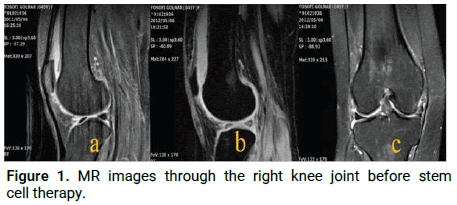
Figure 1: MR images through the right knee joint before stem cell therapy.
Palpable knee joint crepitus was present, equal on both the sides. Musculature around her hip and knee was very tight. Hip and knee Range of Motion (ROM) were restricted and difficult at the terminal ROM. Multiple tender spots were present in B/L adductor, hamstring and calf muscles. Gluteal and quadriceps contraction were weak and against resistance movement were poor.
Investigations
All the blood investigations, blood sugar and X-rays were within normal limits. X-ray lumbar spine and B/L knee joint shows age related degenerative changes. Palpable knee joint crepitus present and swelling and warmth around the knee joint present. No other investigation was done. NCV was planned for sciatic, femoral and obturator nerves but cancelled because patient was reluctant to undergo further testing [3].
Treatment
Patient took treatment from 3 different doctors. All of them advise her oral analgesics, supplements and physiotherapy. All the time, she got momentarily relief in pain but her stiff gradually increased. She also underwent physiotherapy sessions for 6 weeks but without any major relief in pain and discomfort. Her walking distance gradually decreased from 2 Km to 100-150 meters. Most of the time she finds very difficult to get up from sitting position.
After evaluation we plan to target her adductor muscle because she is finding very difficult to straighten her knees and doing abduction at the hip joint. Her adductor muscle was very sore and tender at the bony attachment site.
Under nerve stimulator guidance, we did neurolysis of anterior division of obturator nerve with 5 ml 6% phenol. We took informed written consent from the patient and explain her about the procedure. She immediately relieved in pain and stiffness on passive mobilization. She was advised to take analgesic anti-inflammatory to manage post injection soreness for 3 days [4].
During the next 3 days her walking distance and mobilization was increased gradually, she was advised to do regular stretching of her adductor, hamstring, calf and Iliotibial band. Simultaneous strengthening of abdominal, gluteal and quadriceps muscle was advised. Also, we advised lateral wedge in B/L soles for biomechanical correction. She improved tremendously during the next 15 days and started gaining strength and improved her walking distance to up to 3 km/day. Initially, she did exercises twice daily, which later reduced to once daily.
During her follow up visit after 3 months she was doing very well, with no stiffness and pain either in back or knee. On her 6 months follow up, she is very comfortable and not taking any oral analgesic. Effect of Inj 6% Phenol generally last for 9 months to 2 years and it can be repeated as per our requirement. Simultaneous regular exercises and biomechanical correction help this effect last longer [5].
Our adductors are most commonly known as our inner thigh muscles. Tight adductors will make our back, our hips and even our knees hurt. For a majority of people, our adductors are directly tied to our core strength. This means if we have weak or tight adductors, our other core muscles like our abdominals are less likely to be able to function correctly. This means that if we’re struggling with back pain or a weak core, our tight adductors might be to blame [6].
Adductor muscle tightness refers to the condition where the muscles located on the inside of the thigh, called the adductor muscles, are tense or contracted. This tightness may cause pain in the inner thigh or groin area, as well as discomfort and restricted range of motion. Several factors, such as overuse, imbalanced muscles, insufficient stretching or injury, can cause it.
It’s critical to include stretching and strengthening exercises in your routine to address adductor muscle tightness.
There were several reports stating that hip abductor muscle strength played a major role for reducing knee adduction moments, because it counteracts pelvic drop in the contralateral swing limb during the single-limb stance phase of gait. This intensifies forces at the medial compartment knee of the stance limb [7].
Hip abductor exercises were of interest as an adjuvant exercise for OA knee patients [8]. This was based on the hypothesis that gluteus medius muscles effected external knee adduction moment during level walking. But we found that by balancing the activity of hip adductors have profound effect on pain and stiffness of back and knee joint [9]. Tight adductors didn’t allow a good amount of abduction movement and it is very difficult to perform routing abductor strengthening. Not much literature is available on “Tight adductors, a possible reason for back and knee pain” and it is the most common factor for knee pain in today’s modern life.
We are finding more literature and scientific reviews on “role of tight adductors as the possible reason for OA knee” [10].
As we aware that most of the knee and back pain are mechanical in nature and largely because of our faulty biomechanics, it is better to find a simple and long-term solution instead of just relying on pain management followed by surgical intervention. Our life-style is changing as our dependency on modern lifestyle. It’s always good to cure the cause instead of just treating the effect. This is just an initial step in finding an alternative and long-lasting solution for the knee pain.
[Crossref] [Google Scholar] [PubMed]
[Crossref] [Google Scholar] [PubMed]
[Crossref] [Google Scholar] [PubMed]
[Crossref] [Google Scholar] [PubMed]
[Crossref] [Google Scholar] [PubMed]
[Crossref] [Google Scholar] [PubMed]
[Crossref] [Google Scholar] [PubMed]
[Crossref] [Google Scholar] [PubMed]
Citation: Singh S. "Management of a Case of Chronic Back and Knee Pain with Obturator Nerve Block". Med Rep Case Stud, 2025, 8(6), 1-2.
Received: 18-Nov-2024, Manuscript No. MRCS-24-152791; Editor assigned: 21-Nov-2024, Pre QC No. MRCS-24-152791 (PQ); Reviewed: 05-Dec-2024, QC No. MRCS-24-152791; Revised: 01-Jan-2025, Manuscript No. MRCS-24-152791 (R); Published: 29-Jan-2025, DOI: 10.37532/mrcs.23.8.6.001-002
Copyright: © 2025 Singh S. This is an open-access article distributed under the terms of the Creative Commons Attribution License, which permits unrestricted use, distribution and reproduction in any medium, provided the original author and source are credited.