
Research Article - (2025) Volume 14, Issue 1
Cultivated peanut, as a major oil and cash crop, plays a critical role in ensuring global oil production security. The Sieve Element Occlusion (SEO) gene, which encodes phloem structural proteins widely distributed across plants, is essential for plant growth, development, and stress responses. However, a comprehensive analysis of SEOs in peanuts has not been conducted to date. In this study, a total of 36 AhSEOs were systematically identified and mapped to 10 chromosomes. Analysis of deduced protein properties, gene structure, conserved motifs, and cis-acting regulatory elements revealed the diverse characteristics of AhSEOs. The expression profiles of the 36 genes in 22 tissues revealed that they might have different roles. Among them, two genes, AhSEO15 and AhSEO33, were specifically expressed in root and nodule. Resequencing data from two lines with differing drought resistance, wild-type H2014 and its mutant H1314, revealed a Single Nucleotide Polymorphism (SNP) in AhSEO15 that leads to premature translation termination and alters its threedimensional structure in H1314. Transformation of Arabidopsis thaliana with AhSEO15 demonstrated that, under osmotic stress, plants overexpressing AhSEO15 exhibited higher seed germination rates and improved root growth compared to wild-type plants, suggesting that this gene may play a role in drought resistance. Moreover, lines overexpressing AhSEO15_H2014 showed enhanced drought resistance, whereas lines overexpressing AhSEO15_H1314 displayed reduced drought tolerance, highlighting the potential link between gene structure and drought stress resistance.
Peanut • SEO genes • Expression profile • Drought stress • Functional analysis
Phloem proteins (P-proteins) play a crucial role in plant growth and development by providing mechanical support to nonconducting phloem tissues. When sieve elements are damaged in higher plants, P-proteins facilitate an efficient wound-sealing mechanism to prevent nutrient loss. In most species, P-proteins form a parietal layer within mature sieve elements and accumulate as large plugs, which help minimize the loss of assimilates following wounding. Previous studies have shown that a type of Pprotein, called forisomes, undergoes a reversible conformational change from a condensed to a dispersed state, which effectively blocks the flow in the sieve tube and prevents swelling and excessive loss of photosynthates after injury.
The Sieve Element Occlusion (SEO) gene was first identified as encoding a structural component of forisomes in leguminous plants. All SEO proteins share three conserved domains: The SEON- terminal domain (SEO-N), a potential thioredoxin-folding domain, and the SEO-C-terminal domain (SEO-C). In Arabidopsis thaliana, two AtSEO mutants, AtSEOa and AtSEOb, were found to redundantly contribute to filament formation. In tobacco, SEO protein was shown to directly participate in sieve tube sealing, preventing the loss of photosynthates). SEOs have also been identified in several non-leguminous plants, indicating that the SEO gene is widespread in dicotyledonous angiosperms. The conserved sequences and expression patterns of SEOs across different species suggest potential functional redundancy among corresponding proteins.
Peanut is a major oil and cash crop globally, covering an area of 25 million hectares and producing approximately 46 million tons annually. As the world’s largest producer, China leads global peanut production, playing a crucial role in ensuring national grain and oil security. The rapid advancement of genomic research in peanut, including complete genome sequencing, has provided a solid foundation for identifying gene families involved in stress responses at the genome-wide level. While SEO genes have been studied in several oilseed crops, such as soybean, no studies on SEO genes have yet reported in peanut. In this study, we investigated the SEO genes in cultivated tetraploid peanut using published genome sequencing and transcriptomic data. We analyzed the characteristics and expression patterns of AhSEOs and explored the potential role of AhSEO15 under drought stress. These findings will provide a theoretical framework for future studies on the molecular mechanisms of drought stress tolerance in peanuts [1].
Plant materials and treatments
In this study, two peanut lines, H2014 (wild-type) and its EMSinduced mutant H1314, provided by Henan Agricultural University, China, were used as experimental materials. Healthy seeds were selected, surface-sterilized, and then placed in black plastic boxes containing Hoagland’s nutrient solution to promote germination in an artificial climate-controlled chamber at 30°C (16 h light/8 h dark, relative humidity 60%). When the seedlings reached the four-leaf stage (approximately 30 days), they were transferred to 2 L of 20% PEG6000 solution for drought stress treatment. Samples were collected at 0 h, 12 h, 24 h, 36 h, 48 h, and 72 h, respectively. The experiment was repeated three times, with water used as the control. All samples were immediately frozen in liquid nitrogen and stored at -80°C for subsequent analyses [2].
Seeds of A. thaliana ecotype Columbia were surface-sterilized by treating with ethanol for 10 minutes, followed by 0.05% mercuric chloride for three minutes. The seeds were then washed thoroughly six times with sterile water. After stratification at 4°C for 64 hours, the sterilized seeds were planted on MS medium (MS salts, 2% sucrose, and 0.8% agar) or a synthetic soil mix. The seeds were grown at 23°C with a 16-hour light/8-hour dark photoperiod under fluorescent light (7000 lux at 20 cm) in a plant growth chamber [3].
Identification of AhSEO genes
The SEO genes from A. thaliana and soybean were used as queries to search the reference genomes of A. hypogaea and its two ancestral diploid species, A. duranensis and A. ipaensis, available on PeanutBase, using BLASTP and TBLASTN analyses. The SEO protein sequences of Arabidopsis and soybean were obtained from the Arabidopsis Information Resource and the Phytozome 9.0 database (http://www.phytozome.net/soybean), respectively. Reciprocal BLASTP analysis was conducted to confirm that the subject hits closely matched the SEO family queries. Finally, the BLAST results were validated using Hidden Markov Model (HMM) analysis with SEO domain profiles PF14576 and PF14577 [4].
Physicochemical properties of AhSEO proteins
The physical and chemical properties of AhSEO proteins, including predicted amino acid length and composition, relative Molecular Weight (MW), theoretical isoelectric point, instability index, and atomic composition, were analyzed using the ExPASy server. Subcellular localization of the AhSEO proteins was predicted using the online tool CELLO.
Chromosome localization and synteny of AhSEOs
The chromosome distribution of the AhSEO genes was predicted with MapGene2Chromwebv2. The downloaded protein sequences were analyzed to identify the set of homologous genes using MCScanX [5].
Gene structure, conserved motifs and cis-acting regulatory elements of AhSEOs
The gene structures of the AhSEO genes were predicted using GSDS 2.0). Conserved motifs were identified with MEME software by setting the maximum number of motifs to 10 and keeping other parameters as default. The 2000 bp sequences upstream of the 5’untranslated region of AhSEO gene family members were analyzed using PlantCARE to identify cis-acting regulatory elements. The results were visualized using the visualization tools in TBtools software [6].
Phylogenetic analysis of SEO gene family
The annotated SEO proteins were aligned using ClustalW for multiple sequence alignment analysis. A phylogenetic tree was then constructed based on the protein sequences using the Maximum Likelihood (ML) method in MEGA5, with a bootstrap test performed using 1000 replications.
Expression profiles of AhSEOs
The estimated expression levels (RPKM values) of each AhSEO gene across 22 different tissues and developmental stages were obtained from PeanutBase. The 22 tissues included young leaf, main stem leaf, lateral stem leaf, vegetative stem tip, reproductive stem tip, root, root nodule, perianth, pistil, stamen, aerial pistil tip, underground pistil tip, Pattee1 pod, Pattee1 stem, Pattee3 Pod, Pattee5 peel, Pattee5 seed, Pattee6 peel, Pattee6 seed, Pattee7 seed, Pattee8 seed and Pattee10 seed, as described on PeanutBase. The expression data were reanalyzed, log-transformed, and visualized using TBtools software, with heatmaps constructed to display the results [7].
qRT-PCR analysis
Total RNA was extracted using the TransZol Plant RNA Kit (tRAN, Beijing) following the manufacturer’s instructions. RNA concentration and quality were assessed with a NanoDrop 2000 spectrophotometer (Thermo Fisher Scientific, Finland). cDNA synthesis was performed with 2 μg of RNA in a 20 μL reaction volume using the EasyScript One-Step gDNA Removal and cDNA Synthesis SuperMix (TRAN, Beijing) as per the manufacturer’s protocol.
Quantitative Real-Time PCR (qRT-PCR) analysis was conducted on a PikoReal 96 real-time thermal cycler and a CFX96 touch real-time PCR System (Bio-Rad, Hercules, CA, USA) using TB Green Premix Ex Taq II (Tli RNaseH Plus) mix (TaKaRa, Japan). Specific primers were designed using the Primer 3.0 software (http://frodo.wi.mit.edu/ primer3/input.htm). All reactions were carried out in triplicate using three independent pooled samples. Relative expression levels were calculated using the 2-ΔΔCt method, with actin17 serving as the internal control [8].
Subcellular localization of AhSEO proteins
To determine the subcellular localization, full length of coding sequences without stop codon of AhSEO genes were fused into pCAMBIA1300-35S-GFP vector. The fusion plasmids were subsequently transformed into Agrobacterium tumefaciens. Leaf of one-month-old tobacco was used to transiently express the fusion AhSEO-GFP proteins. The green fluorescence was observed through the laser scanning confocal microscope (Leica TCS SP8, Germany) after infected for three days [9].
Transformation and drought tolerance assay
To construct an expression vector for Arabidopsis, the full-length ORF of the candidate genes was amplified and cloned into the PHB vector, which was then introduced into Arabidopsis plants via the floral dip method as described previously. Transformants were selected on MS medium with 50 mg/mL kanamycin, and RT-PCR was performed to confirm gene expression in the transgenic lines. Plants were cultivated under standard growth conditions (16 h light/8 h dark) at 23°C. For drought stress assays, seeds were sown on 1/2 MS medium containing 0 mM, 100 mM, or 200 mM mannitol. After one week, the seed germination rate and root length were measured to evaluate drought tolerance (Figure S1).
Identification and characterization of AhSEOs
Based on the presence of conserved SEO domains, PF14576 (Nterminus) and PF14577 (C-terminus), the A. hypogaea genome was analyzed to identify potential AhSEO genes. A total of 36 SEO genes were identified and named AhSEO1 to AhSEO36 (Table S1). Bioinformatics analysis revealed that the encoded proteins ranged in length from 102 to 994 amino acids, with isoelectric points varying from 5.63 to 8.54. Subcellular localization predictions suggested that most AhSEO proteins were localized to mitochondria or the extracellular space, whereas AhSEO17 and AhSEO5 were predicted to be localized in the peroxisome and chloroplast, respectively.
The 36 AhSEO genes were unevenly distributed across 12 of the 20 chromosomes (Figure 1). While 15 AhSEOs were located in the A sub-genome and another 15 in the B sub-genome, 10 AhSEOs were tightly and tandemly clustered on chromosomes 9 and 19. Consistent with findings in Arabidopsis and other species, the highdensity distribution of AhSEO genes in certain chromosomal regions may be attributed to repetitive duplication events.
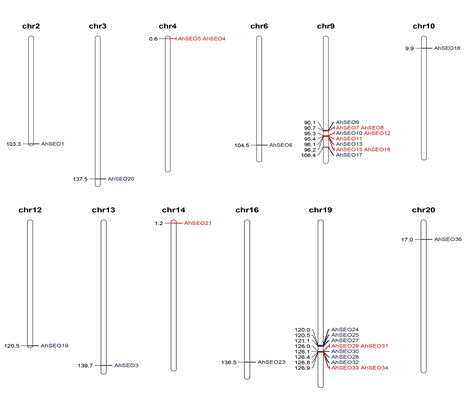
Figure 1. The chromosomal location and distribution of 36 AhSEO genes. Chromosome size is indicated by its relative length. The physical locations of AhSEOs are drawn on each chromosome.
Collinearity and phylogenetic analysis of SEO genes
The collinearity of AhSEO genes with those of their diploid progenitors was analyzed based on chromosomal segments (Figure 2A). Among 23 pairs of duplicated fragments, 15 pairs were located on chromosomes 9, 19, A09, and B09, suggesting that these regions underwent strong selection during Arachis cultivation. No tandemly duplicated genes were identified, indicating that the evolution of SEO genes in Arachis was driven solely by segmental duplication events.
A phylogenetic tree was constructed, including 36 AhSEO genes, 20 AdSEO genes from A. duranensis, 14 AiSEO genes from A. ipaensis, and 18 SEO genes from other dicot species such as soybean (Glycine max), Vigna angularis, Cajanus cajan, Senna tora, Medicago sativa, Juglans regia, and Ziziphus jujuba (Figure 2B). All SEO genes were grouped into 10 clusters, with subfamilies IV and X being the largest, containing 20 and 19 members, respectively. The analysis revealed a clear distinction between dicotyledons, including Arachis, and monocotyledons within subgroup IX.
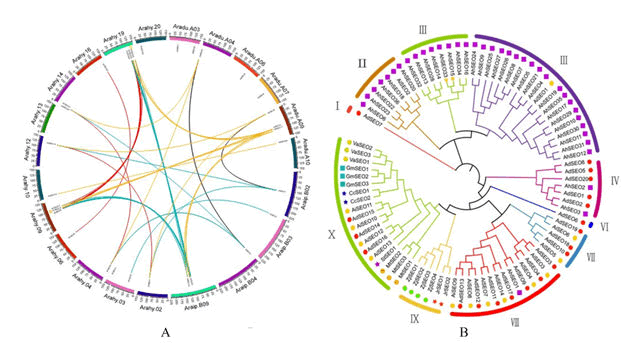
Figure 2. Synteny analysis (A) and phylogenetic relationship (B) of SEO genes. (A) Synteny analysis of SEO genes from A. duranensis, A. ipaensis, and cultivated peanut (A. hypogaea). Gene locations are represented as follows: Aradu (A. duranensis), Araip (A. ipaensis), and Arahy (A. hypogaea). (B) Phylogenetic analysis of SEO genes across 10 species. An unrooted maximum likelihood tree was constructed, with members from different species distinguished by various shapes to indicate their groupings.
Gene structure and conserved motif analysis of AhSEOs
Gene structure analysis revealed that AhSEOs were highly conserved, with similar exon/intron numbers across most genes (Figure 3). The majority of AhSEOs contained 10 motifs, corresponding to conserved domains arranged in a specific order. Based on gene structure and conserved motif composition, AhSEOs were grouped into four clusters (I–IV). The conserved domains SEO_C and SEO_N corresponded to Motif 1, Motif 2, Motif 4, and Motif 7. Notably, all AhSEOs except AhSEO3 and AhSEO22 contained both Motif 1 and Motif 7, suggesting that these motifs may play a critical role in AhSEO function. Genes in cluster IV exhibited more complex gene structures and variable motif patterns. For instance, AhSEO22, which harbored only one motif, may have distinct functions or expression patterns compared to other AhSEO genes.
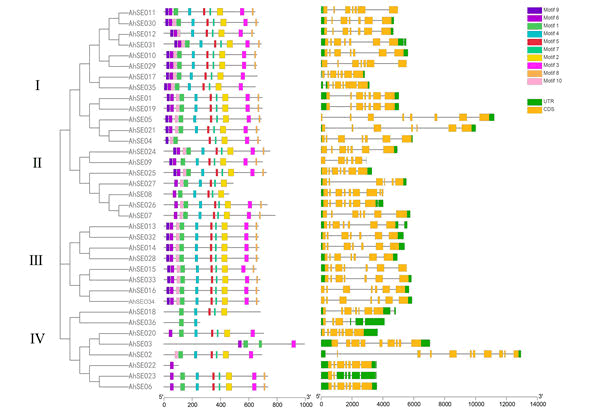
Figure 3. Gene structure and conserved motif analysis of the AhSEO family. (A) The Neighbor-Joining (NJ) phylogenetic tree and distribution of conserved motifs of the AhSEO family. (B) Exonintron structure of AhSEO genes.
Expression patterns and promoter analysis of AhSEO genes
Transcriptomic data were used to analyze the expression patterns of AhSEO genes across 22 tissues (Figure 4A). The results revealed that AhSEO3 was most highly expressed in the perianth, followed by seeds, with low expression levels in other tissues. AhSEO15 and AhSEO33 were predominantly expressed in roots and root nodules.
Promoter analysis of AhSEO genes identified hormone-responsive elements such as those responsive to Methyl Jasmonate (MeJA), Abscisic Acid (ABA), Auxin (IAA), and Gibberellin (GA) (Figure 4B). Notably, AhSEO15 and AhSEO33 contained defense and stressrelated as well as wound-response elements, suggesting their potential involvement in stress responses.
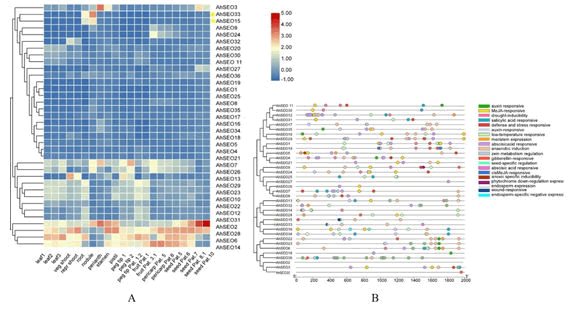
Figure 4. The expression profiles and cis-element analysis of all AhSEO genes. A) The expression abundance of each transcript is represented by the normalized Fragments per Kilobase per Million (FPKM) value and displayed as colored boxes from blue (lower expression) to red (higher expression). All the tissues were referred as peanutBase. B) Left column showed the locations of ciselements in the 2 kb sequences upstream of AhSEO genes. Different kinds of cis-elements are represented with different colors. Right column showed the detailed functional annotations of cis-elements.
Based on whole-genome re-sequencing results for H1314 and H2014 (data not shown), a SNP was identified in the 456 bp position of AhSEO15 in H1314, involving a G>A substitution. This mutation introduced a premature termination codon (TGA), potentially leading to the early termination of AhSEO15 (Figure 5). The SNP was further validated by comparing the Coding Sequences (CDS) of AhSEO15 between H2014 and H1314 (Figure 5A) using gene-specific primers designed (Table S2). Predictive analysis indicated that this mutation altered both the domain structure (Figure 5B) and tertiary structure (Figure 5C).
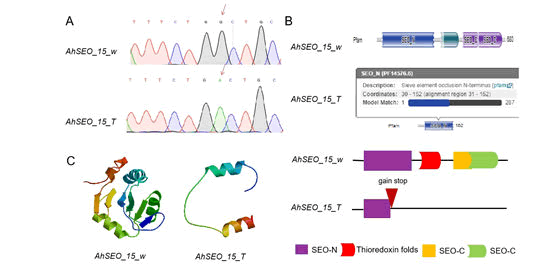
Figure 5. Validation of the non-synonymous mutation of AhSEO15 in wide type and the mutant. A) Location of the SNP; B) Structure prediction of AhSEO15; C) Changes of tertiary structure and domains.
Drought stress alters the expression of AhSEO15 genes
H2014 and the mutant H1314 were subjected to 20% PEG6000 treatment to assess their responses to drought stress. The results showed that both the total root length (Figure 6A) and root diameter (Figure 6B) of H1314 were significantly lower than those of H2014, indicating that H2014 is more resistant to drought stress than H1314. To investigate the potential role of AhSEO15 in drought stress response, its expression patterns were analyzed in roots and leaves. Under drought stress, AhSEO15 expression in roots gradually increased over 24 hours, peaking at 36 hours, and then decreased (Figure 6C). In leaves, AhSEO15 showed a sharp upregulation, reaching its maximum at 24 hours, followed by a decline after 36 hours (Figure 6D). Although the expression patterns of AhSEO15 were similar between H1314 and H2014, significant differences were observed in expression levels at all-time points, suggesting a differential role of AhSEO15 between the two lines under drought stress. overexpression of AhSEO15 affects growth of Arabidopsis under osmotic stress.
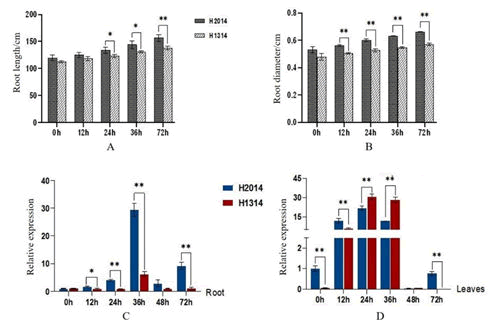
Figure 6. Physiological respond to drought stress and relative expression of AhSEO15 in H2014 and H1314. under the drought stress. A and B were the root length and root diameter of two lines under the drought stress, respectively; C and D were the relative expression of AhSEO15 in roots and leaves under the drought stress, respectively. All the data from at least three times was presented as mean ± Standard Error (SE). Asterisk indicates significant variation in transgenic lines compared with Col-0 by student’s t-test analysis with p<0.05 (*) and p<0.01 (**), respectively.
Subcellular localization was generally used for gene functional research in view of implying the functional position of a protein. To detect the subcellular localization of AhSEO15, the fused protein with GFP was used to transiently express in the leaves of Nicotiana benthamiana (Figure 7A). Both P35S::AhSEO15_W-GFP (H2014) and P35S::AhSEO15_T-GFP (H1314) proteins were found to be localized in Endoplasmic Reticulum (ER), which was consistent with the bioinformatic analysis.
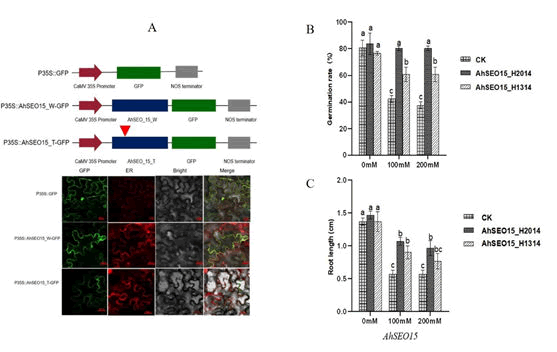
Figure 7. Subcellular localization analysis of AhSEO15 proteins and respond to drought stress of transgenic lines overexpressing AhSEO15. A) Vector construction map and subcellular location results observed through the laser scanning confocal microscope; B) Germination rate of seeds from AhSEO15-overexpressed plants and Col-0 under normal and drought stress conditions; C) Root length of AhSEO15-overexpressed plants and Col-0 under normal and drought stress conditions. All the data from at least three times was presented as mean ± Standard Error (SE). Lowercase letters indicate significant variation in transgenic lines compared with Col-0 by student’s t-test analysis with p<0.05.
To further investigate the potential biological function of AhSEO15 under osmotic stress, transgenic Arabidopsis plants overexpressing AhSEO15-H1314 and AhSEO15-H2014 were generated under the control of the 35S promoter. Seeds from wildtype and T2 transgenic lines were sown on 1/2 MS mediwith 0 mM, 100 mM, or 200 mM mannitol and cultured for one week to evaluate seed germination rates (Figure 7B) and root lengths (Figure 7C). On 1/2 MS medium without mannitol (0 mM), the seeds of wild-type Arabidopsis and the two transgenic lines germinated normally, with germination rates exceeding 80%, and showed no significant differences. However, on 1/2 MS medium containing 100 mM or 200 mM mannitol, germination was significantly inhibited in both wild-type plants and transgenic lines overexpressing AhSEO15- H1314 gene. In contrast, transgenic seedlings overexpressing AhSEO15-H2014 gene exhibited the highest germination rates, showing significant differences compared to the other lines. On medium without mannitol, the root lengths of wild-type and transgenic Arabidopsis seedlings were similar. Under 100 mM mannitol stress, the root lengths of both transgenic lines were greater than those of the Wild-Type (WT) seedlings. However, under 200 mM mannitol stress, only the transgenic lines overexpressing AhSEO15-H2014 gene showed a significant increase in root length compared with the WT.
Although there was no statistically significant difference in root length between the two transgenic lines, seedlings overexpressing AhSEO15-H2014 gene consistently exhibited longer roots than those overexpressing AhSEO15-H1314 gene. These findings suggest that overexpression of AhSEO15 promotes Arabidopsis growth and development during the early seedling stage under osmotic stress. Furthermore, AhSEO15-H2014 appears to have a more pronounced effect on enhancing growth under osmotic stress compared to AhSEO15-H1314.
Peanut, an economically significant leguminous crop, is cultivated in over 100 countries and serves as an excellent source of vegetable oil and protein, contributing to human nutrition and health. However, its yield and quality are often significantly reduced by various biotic and abiotic stresses throughout its growth stages. Identifying and cloning key genes associated with agronomic traits is essential for crop genetic improvement. Despite extensive efforts over the years employing diverse methods, genetic transformation in peanut has not achieved major breakthroughs, thereby limiting progress in peanut functional genomics.
SEO (Sieve Element Occlusion) proteins are known to play critical roles in material transport, maintaining plant structure, and providing resistance against external physical damage. While the SEO gene family has been studied in other species-ranging from three members in A. thaliana to 26 in soybean (G. max)-a systematic investigation of SEO genes in peanut has been lacking. In this study, 36 SEO family members were identified in cultivated peanut (A. hypogaea), marking the first comprehensive exploration of their characteristics, expression patterns, and potential functions. The number of SEO genes in A. hypogaea exceeded those found in its diploid ancestors: 20 in A. duranensis and 14 in A. ipaensis. Previous research suggests that genome-wide triplication events, coupled with gene duplication, massive gene loss, and chromosomal rearrangements, contributed to this diversity.
Phylogenetic analysis offered insights into gene classification and potential functional relationships. The constructed phylogenetic tree revealed that the AhSEOs share a close evolutionary relationship with other dicotyledons, suggesting a relatively recent period of species divergence. The expression patterns of SEO genes in response to wounding and sealing have been reported in various plants, including G. max and A. thaliana. Previous studies revealed that, with a few exceptions, most GmSEO genes are highly expressed in phloem-enriched tissues, where they play a critical role in sieve element occlusion. Tissue-specific expression analysis of peanut AhSEO genes indicated that most were expressed at relatively low levels across the 22 tissues examined. However, AhSEO33 and AhSEO15 exhibited higher expression in roots and nodules compared to other tissues, suggesting that these genes may play important roles in root growth and nodulation. Phloem structural proteins, such as those encoded by SEO genes, are known to contribute to plant stress and disease resistance. Drought tolerance in plants is primarily influenced by root traits such as root length and lateral root density. In this study, AhSEO15 expression levels in the roots and stems of H2014 were significantly higher than those in H1314, whereas no notable differences were observed in their leaves.
Next-Generation Sequencing (NGS) offers a powerful tool for generating large-scale sequence datasets, enabling the characterization of sequence diversity and the production of polymorphic and genotypic data essential for genetic mapping, genetic diversity analysis, gene identification, and molecular breeding. Single Nucleotide Polymorphisms (SNPs) and small insertions and deletions (InDels) have been widely applied in genome and transcriptome studies across humans, animals, and plants. In this study, an SNP was identified from re-sequencing data (data not shown) of H2014 and H1314, two peanut lines with differing drought resistance, and its presence was validated experimentally. Further analysis revealed that this nonsense mutation likely altered a conserved domain and the tertiary structure of the corresponding protein, potentially impairing its function.
SEO proteins, which possess lectin-like characteristics, are known to play roles in stress responses. Theoretical evidence suggests that lectin proteins are involved in a range of stress mechanisms. Notably, overexpression of a lectin protein in A. thaliana has been shown to enhance tolerance to osmotic stress. Similarly, AhSEO15 expression was specifically induced under drought stress in this study, supporting its potential involvement in the regulatory mechanisms of stress adaptation. Previous studies have demonstrated that SEO genes play significant roles in stress resistance across various crops, including A. thaliana, tobacco, and soybean. In this study, AhSEO15 was found to respond positively to drought stress in peanut. Transgenic Arabidopsis lines overexpressing AhSEO15 exhibited enhanced resistance to osmotic stress, although the two haplotypes of AhSEO15 showed varying degrees of resistance.
These findings suggest that AhSEO15 is involved in drought stress responses, with different haplotypes contributing to varying levels of adaptation. However, further research and extensive experimental validation are required to fully elucidate the functions of SEO genes in peanut. The identified SNP in AhSEO15 holds potential for the Assisted Selection (MAS) to improve drought resistance in peanut breeding programs.
A total of 36 SEO genes were identified in the tetraploid cultivated peanut (A. hypogaea). Phylogenetic analysis classified the SEO proteins into 10 subfamilies. The SEO gene family in peanut appears to have undergone segmental duplication events between the A and B sub-genomes. Several SEO genes exhibited tissuespecific expression patterns and are potentially involved in abiotic stress responses. Among them, AhSEO15 showed high expression levels in roots and was strongly induced by drought stress. Transgenic A. thaliana plants overexpressing AhSEO15 demonstrated enhanced tolerance to osmotic stress. These findings provide valuable insights into the evolution of AhSEOs and offer a foundation for further research into their roles in regulating plant stress tolerance.
XG Zhang, XL Ma and DM Yin designed the project. YY Ma and D Qiu carried out computational analysis. YY Ma, Y Yang and YH Liu performed RNA-seq expression profiling. YY Ma performed the experiments. XG Zhang and YY Ma wrote the manuscript. ZF Li, FP Gong and L Zhang revised the manuscript and gave constructive comments. Both authors read and approved the final manuscript.
The authors declare no conflict of interest.
[Crossref] [Google Scholor] [PubMed]
[Crossref] [Google Scholor] [PubMed]
[Crossref] [Google Scholor] [PubMed]
[Crossref] [Google Scholor] [PubMed]
[Crossref] [Google Scholor] [PubMed]
[Crossref] [Google Scholor] [PubMed]
Received: 29-Nov-2024, Manuscript No. JBTW-24-153626; Editor assigned: 03-Dec-2024, Pre QC No. JBTW-24-153626 (PQ); Reviewed: 17-Dec-2024, QC No. JBTW-24-153626; Revised: 11-Feb-2025, Manuscript No. JBTW-24-153626 (R); Published: 18-Feb-2025, DOI: 10.35248/2322-3308.25.14.1.005
Copyright: © 2025 Zhang X, et al. This is an open-access article distributed under the terms of the Creative Commons Attribution License, which permits unrestricted use, distribution, and reproduction in any medium, providrobed the original author and source are credited.